Research Topic
Legacies
The photographs taken by skilled and dedicated amateur photographs come closer than those of professionals to the image of farm women held by the residents of rural Sweden. The conception of agrarian womanhood expressed in these images was deeply rooted in rural culture and changed more slowly than the gender division of labor itself. Women embodied physical strength and endurance. In fact, their gender-specific tasks in haying and harvest were more strenuous than those of men, as they stooped to gather and bind grain while men increasingly rode horse-drawn machinery. Women’s wider range of skills meant they could substitute for men in the fields and carry out heavy tasks when the men were away or otherwise occupied.
At the same time, farm women’s control of milking and butter and cheese making diminished as dairying became more profitable and more central to farm income. When milk processing was centralized and mechanized, farm women devoted the time they saved to milking more cows. Men entered the cowshed only when the labor was lightened by milking machines. A similar irony occurred in dairies. As the physical labor required became less taxing and the machinery was increasingly automatic, men replaced women as skilled workers in milk processing plants. On larger-scale capitalist farms, too, women were hired to do the milking and the stoop labor in the fields.
Given these conditions, many unmarried, self-supporting women left rural areas for jobs in urban centers that did not demand such endless toil and offered a degree of independence. As the married women who remained on family farms increasingly worked alone, rather than with their unmarried adult daughters, sisters, and sisters-in-law, their burdens increased. The expectation that farm women would “get up and do what needed to be done” remained, and as men on smaller farms increasingly took off-farm jobs, daughters remembered that their mothers “did whatever farming was done on the place” as well as gathering berries for sale.
Those who grew up in the countryside but moved to urban areas after the Second World War carried this concept of women as economically productive, physically strong, and capable of performing a wide range of skilled tasks with them, and it influenced their views on the key issues of economic and social policy in the postwar period. They took it for granted that most women, including the mothers of young children, would be gainfully employed, so they supported child allowances and subsidized childcare to facilitate this combination of productive and reproductive labor. Rural residents allied with the urban working class to equalize the incomes and living standards of those engaged in agriculture with those of industrial workers. Not only did Sweden adopt economic policies that effectively supported the prices farmers received for their products, but farming families enjoyed paid vacations, while those who substituted for them on the farm were paid by the state.
All these policies were adopted well before 1970, when Sweden set out to equalize the status of women and men in the labor force and to treat married women as individuals in the tax and pension systems. Women in farm couples were credited with whatever share of the work they performed, which could be more than half if their husbands had off-farm jobs. These changes met with less resistance in Sweden than in countries where rural women’s work was less visible.
Ultimately, the photographs of rural women’s productive labor that were kept in family albums helped to sustain urban-dwellers’ memories of their grandmothers and great-grandmothers who made vital and valued contributions to families’ livelihoods.
The photographs helped to sustain urban-dwellers’ memories of their grandmothers and great-grandmothers who made vital and valued contributions to families’ livelihoods.
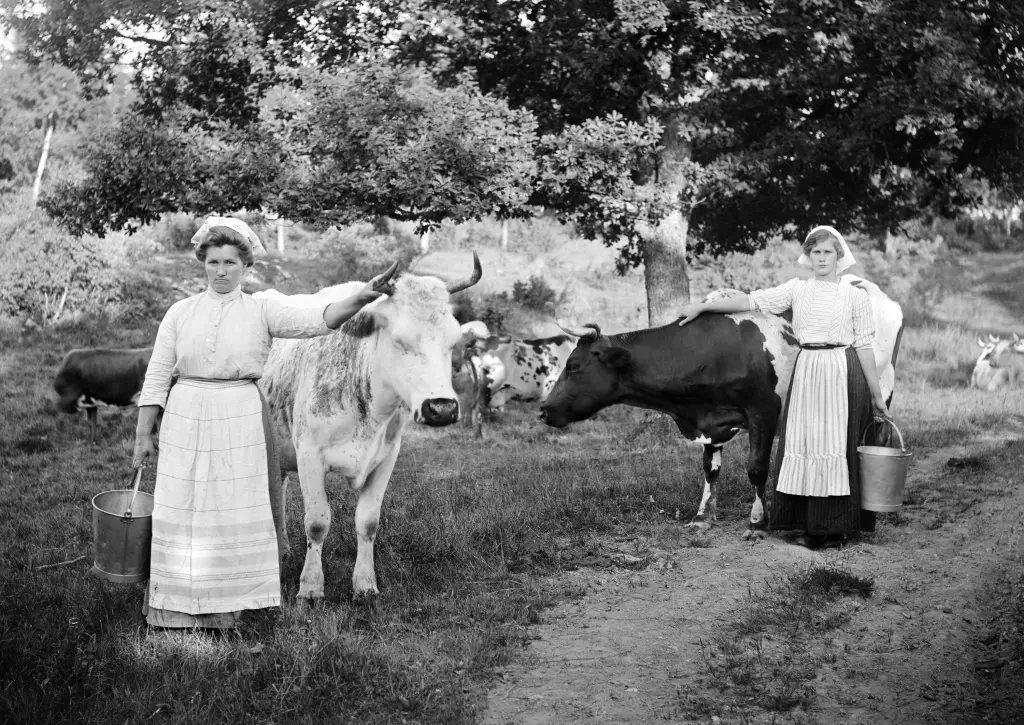
Housekeeper and maidservant with milk cows. Strömmen farm, Sankt Anna parish, Östergötland. Taken by Emil Durling in 1914. Östergötlands museum, Linköping..