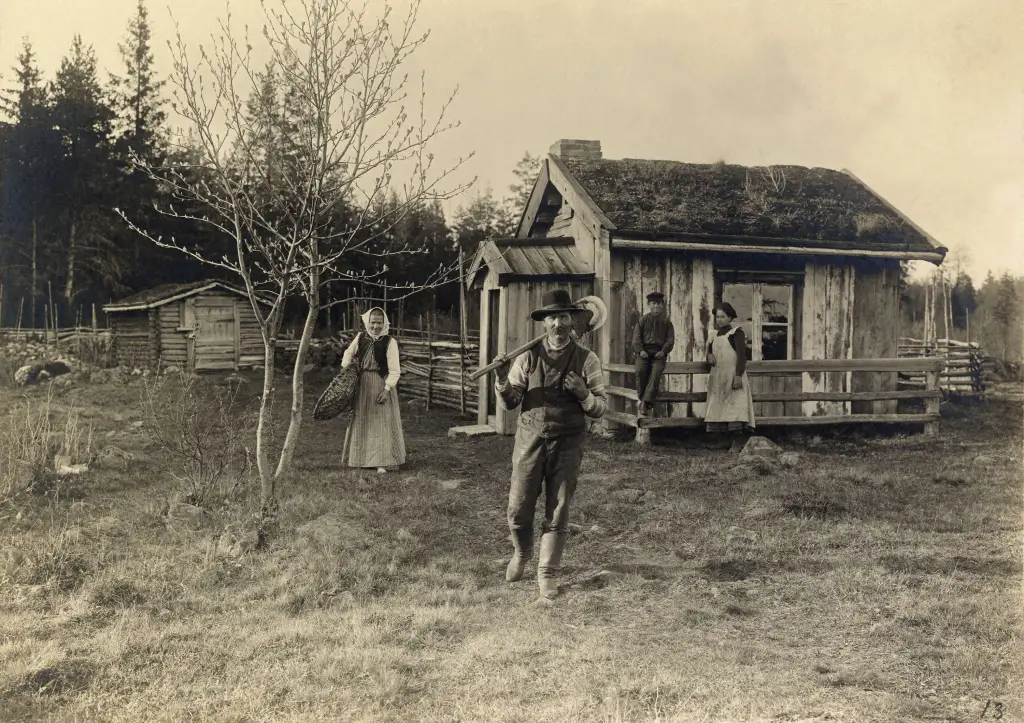
Carl Johan Olson, his wife Maria Sofia Jansdotter, and their children Ester Maria and Josef Hilding in front of the cottage they rented from Melltorp. Hova parish, Skaraborg (now Västergötland). Taken by Gustav Heurlin in the early spring, 1903–1906. Västergötlands Museum, Skara.
Carl Johan Olson (b. 1855) and Maria Sofia Hansdotter (b. 1851) take their tools to work on their landlord’s farm, while their daughter (b. 1890) and son (b. 1892) stay behind. This middle-aged couple, who had been unable to acquire farmland of their own, worked for their landlord both separately and together to p-ay the rent on their dwelling, small shed, and garden plot.
Compare this tenant woman’s material circumstances and labor with that of women in landowning families. Does her physical depiction in relation to her husband resemble theirs? The women in tenant families were not required to spend as many days working for the landlord as the men were, but they were also responsible for the land and livestock on their holding. If the family ran short of cash, the woman could join a gang of women hired by the day to weed or harvest row crops on the landlord’s farm.
Gustav Heurlin (1862–1939), who studied photography in Germany, traveled throughout Sweden and Norway photographing farming families and coastal fishermen as well as the working and wandering poor.
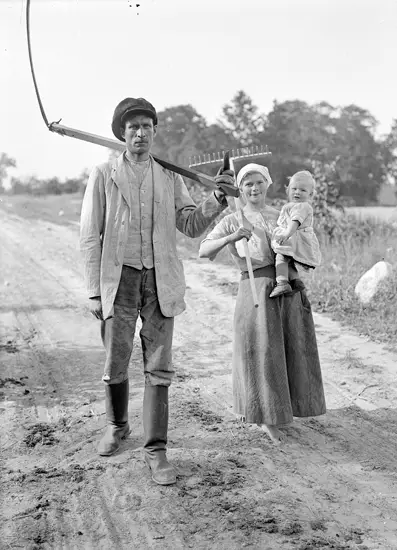
The Fredriksson family, farm laborers, walking to work. Danderyd, Uppland. Taken by Gustav Heurlin in 1920. Nordiska Museet, Stockholm.
In the rural laboring class, husbands and wives could be hired to work as a team during the summer when haying and harvest demanded more workers than the locality could supply. Able-bodied young couples followed the work together, but might seek a year-round position on a larger farm or dream of becoming tenant farmers.
Here Gotthard Fredrik Fredriksson and his wife Edla carry their tools he a scythe, she a rake for making hay or harvesting grain, and bring their two children with them for the day. Like many landless couples, Gotthard and Edla had already traveled from the province of Närke (now Västmanland), where they were born in 1886 and 1890. In another image, their twelve-year-old daughter Elisabet is also shown walking between her parents, but for this one she must have refused to stand still.
Gustav Heurlin depicted this couple as physically fit and as good parents. Without information provided later by a descendent, we would not know of their migration within Sweden in search of steady work and a stable place to live. Nor would we know that their older daughter had tuberculosis the scourge of those who were poor and homeless and died in a state-run sanatorium at the age of thirteen.