Woman pouring milk from a pail into a milk can. Stockholm county (now in Uppland). Taken by Gunnar Lundh in 1935. Nordiska museet, Stockholm.
Consider this striking image of a woman straining milk outside the cowshed on the Börjeson family farm near the Baltic coast north of Stockholm. Three generations were living there—an older couple, their son and his wife, and their young grandchildren—and this woman was the older of the two adult women who milked the cows. Gunner Lundh, Sweden’s most successful professional photographer, recorded this scene of everyday life with his 35 mm Leica. He spent several days with his chosen subjects, observing them as they went about their ordinary activities in their accustomed environment. This representation of a mature farm woman emphasizes the muscular strength she has developed over decades of milking cows, making hay and harvesting grain, and carrying heavy buckets of water. Her posture and poise convey confidence in her ability to carry out tasks that demand physical effort and expert judgment. In this quotidian setting, Lundh presented her with the dignity conferred by her labor.
To its contemporary audience, this photograph represented a familiar conception of agrarian womanhood. As in many other European societies, tending and milking cows had long been women’s responsibility. When farms expanded their herds and sent their milk to centralized dairies for processing into butter and cheese, milking remained a womanly task, but became more physically demanding and exacting. Straining the milk ensured it was free of straw and bacteria from dirty udders, hands, and implements. Until the widespread adoption of machinery after the Second World War, milking was almost entirely in women’s hands—even as dairying became a major source of income for many farmers.

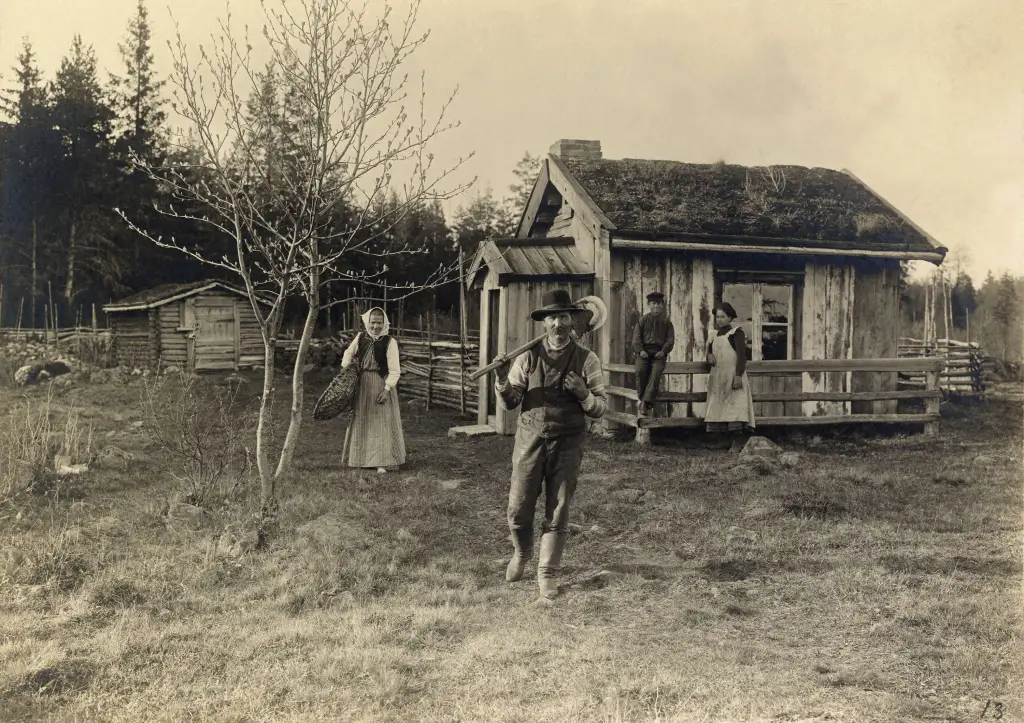
Nyckelberg village’s summer farm. Malung, Upper Dalarna. Taken by Ida Häckner in 1901. Nordiska museet, Stockholm.
This rare photograph, which was taken by a woman, shows women at a summer farm (fäbod),where all-female groups spent several months away from their family and village tending cows and preserving the milk. In more northerly and upland parts of Sweden, the fäbod system of taking cows to higher elevations to graze was essential. Summer farms in Dalarna were a women’s world, as they watched the cows, milked them twice daily, made butter and cheese, and gathered grass from natural meadows to supplement the rough grazing. Some served only one farm, but others were quite large, with pastures cleared of trees but filled with stones, natural meadows, storehouses for hay, and sheds for processing milk and sleeping that served an entire village.
This communal institution, especially as it existed in Dalarna, has been both celebrated and misunderstood. Outsiders saw these women’s “folk dress” as a vestige of the past and invested them with a remarkable degree of independence and slightly salacious but healthy heterosexual freedom. This romanticized image was propagated in the media through the late twentieth century. Women in other regions and urban centers bought mass-produced folk costumes and wore them on Sweden’s national day and at village celebrations, a practice that demonstrates the ability of visual representations and bodily adornments to become detached from their origins and proliferate in other settings. To avoid reproducing this mythical figure, I searched for photographs of women at summer farms taken by women who were natives of the province.
Ida Häckner was among Sweden’s first female professional photographers, and from 1898 to 1909 she was based in Malung. One of seven daughters of an estate owner who was a liberal member of parliament and supported equal rights for women, Ida and all her sisters remained single and pursued professional careers. Häckner had the only studio in Malung and also photographed people in their own settings at home, on farms, and in the landscape. Sadly, she retired in 1909 because she was losing her eyesight. This image is her only surviving photograph in a public institution, although a formal portrait survives in a family album.
Häckner’s carefully composed group photograph emphasizes the autonomy and solidarity enjoyed by women on summer farms, and this image of their meeting with men from the village to discus business reflects the dignity and respect she felt they deserved.