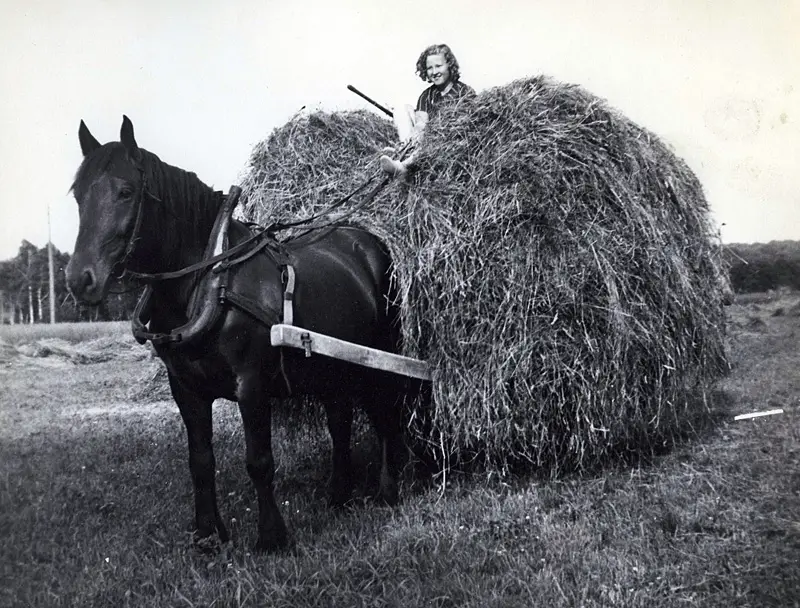
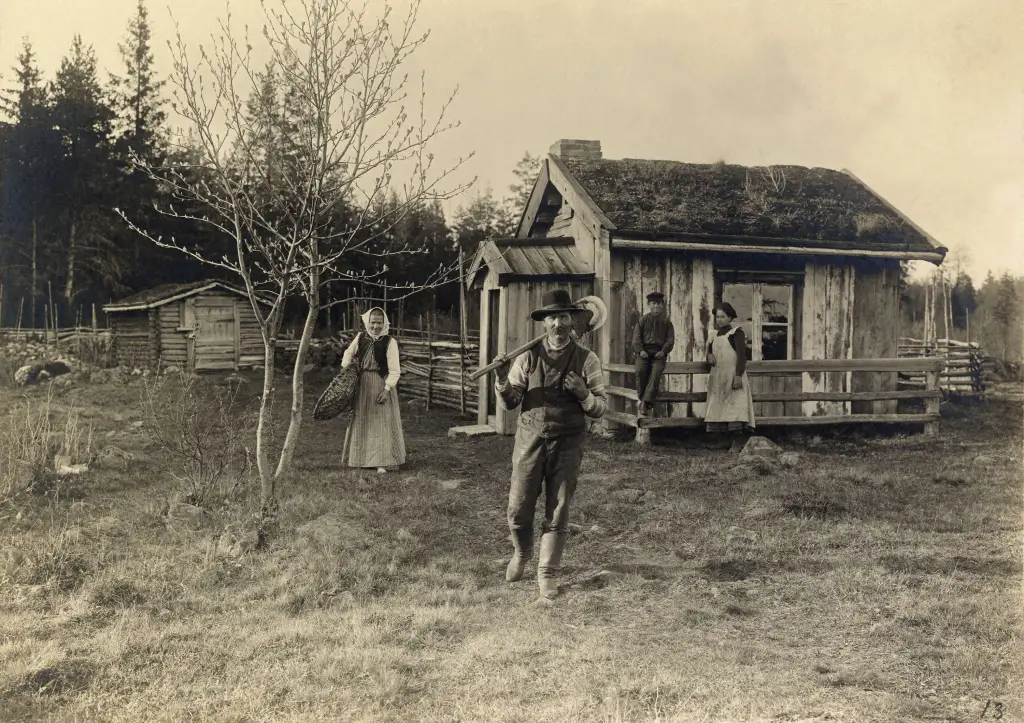
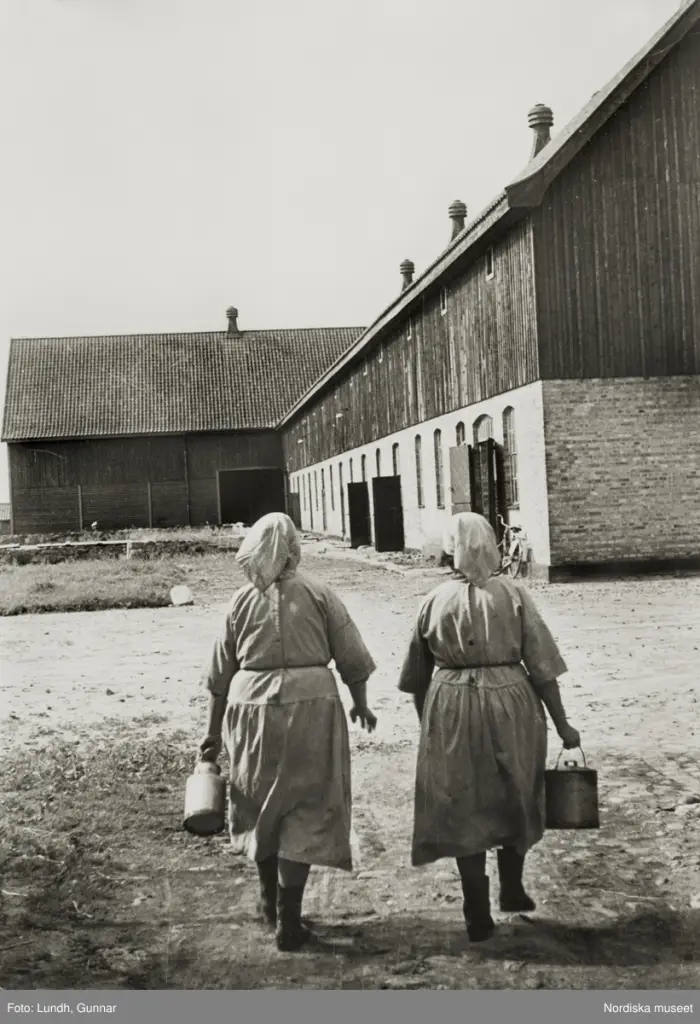
Women servants who lived in farm households were often photographed working alongside their mistress and her daughters outdoors. When those in group photos are listed, they are identified not as maidservants but by name. They can seldom be visually distinguished from family members and relatives when everyone is wearing their everyday clothing. Servants were less permanent than coresident relatives of the landowning family, who also participated in the work. But most came from respectable families in the locality and left service when they married. They did not form a permanent class of transients or occupy an inferior social position.
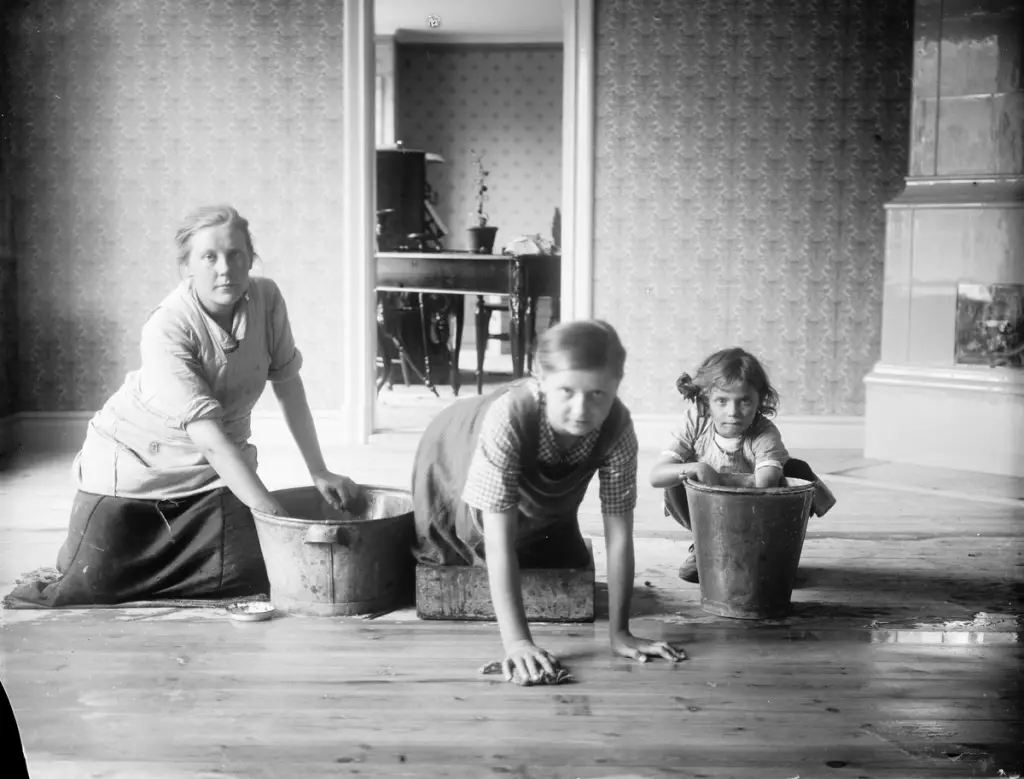
Scrubbing the floor. Revelsta estate, Altuna parish, Västmanland (now in Uppland.) Taken by John Alinder in 1918. Upplandsmuseet, Uppsala.
Contrary to first impressions, this photograph of a woman and two children washing the wooden floor in a well-furnished house does not depict domestic servants. Women and children toiling on their hands and knees indoors or out was often a sign of subordination but not in this instance. Frida Melberg, the wife and mother in the family that rented this beautifully designed house from a nearby estate, is scrubbing the floor with her daughters Helmy and Helga. With thirteen children, it is no wonder that Frida did housework herself. The family often entertained relatives, neighbors and friends in this large, formally decorated room, and before the wedding of one of the Melbergs’ older children was held here, she made sure it shone. the inclination toward social equality that has characterized Scandinavian societies since the early twentieth century draws on the valuation of all forms of labor, including unpaid work.
Bachelor farmers often hired experienced women to manage their households but, like their sisters who married farmers, these women’s responsibilities extended far beyond housekeeping.
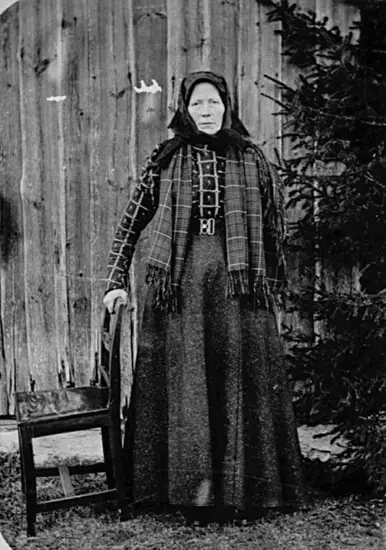
Augusta Svensson, housekeeper on Nyängen farm. Töreboda parish, Skaraborg (now Västergötland). Taken by Erik Rud, 1910–12. Västergötlands museum, Skara.
Some women who never married or did so much later than average were employed in a farm household for years or decades and supervised maidservants. Those known as housekeepers were usually hired by single men or widowers, and their authority resembled that of the wife of the household head or, indeed, the household head himself. Some housekeepers became legendary figures in their neighborhoods.
In the early 1910s, Augusta Svensson, who managed the household of a bachelor farmer, chose to have her portrait taken outdoors, which reflected her self-definition as a farmer rather than a domestic servant. The photographer, Eric Rud, lived nearby. Augusta has a serious expression, but Rud described her as having “a humorous temperament.” She told him that “the dog, the sheep, and the wolf that sometimes appears must have smiled” when she “harrowed the field and undertook other heavy farm work that was traditionally considered manly, and worked in the forest when needed.” Tall, dignified, and warmly clad in layers of patterned clothing, she looks simultaneously womanly and independent, sturdily taking up space and not under anyone else’s authority.
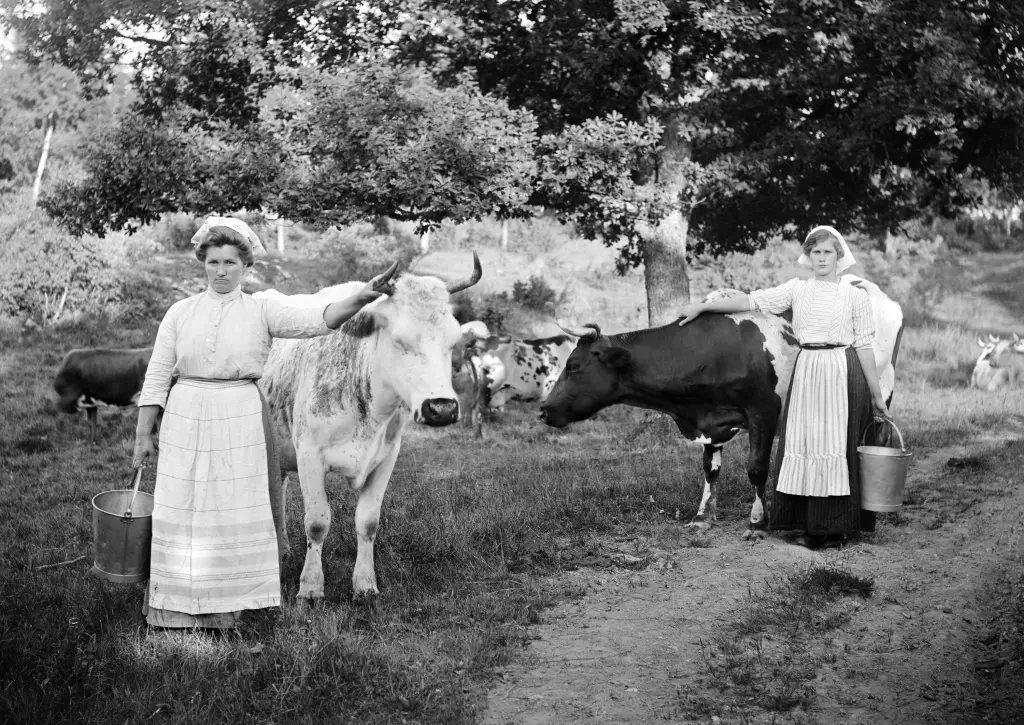
Housekeeper and maidservant with milk cows. Strömmen farm, Sankt Anna parish, Östergötland. Taken by Emil Durling in 1914. Östergötlands museum, Linköping.
Some relationships between bachelor farmers and the women they employed to run the household, do the milking and gardening, and work in the fields at haying and harvest resembled relationships based on kinship; indeed, other bachelor farmers lived with unmarried sisters. These women’s labor was varied, demanding both strength and skill.
Emil Durling, an unmarried farmer, renowned orchardist, and serious camera enthusiast, recorded scenes on his small but intensively cultivated farm and on large estates in his prosperous parish near the Baltic coast south of Stockholm. He employed a housekeeper and at least one maidservant, as well as male and female laborers who were often their relatives and friends.
Here Durling posed his housekeeper and maidservant with the dairy cows before they started milking, which accounts for their spotless aprons and weightless pails. While these hired women are conventionally attractive, their sturdy figures, symmetrical stances, and serious expressions make it clear that they are in full control of the cows, despite the animals’ monumental size.
Durling’s longtime housekeeper, Ester Karlsson, was born in 1887 and grew up on a nearby farm. She was in charge of all the tasks expected of women and others that were generally performed by men. A photograph taken in 1908 shows Ester churning butter in the orchard with her sister Ingeborg and their friend Ölle; another taken in 1911 shows Ester carrying an axe on her shoulder to cut down a Christmas tree in the snowy woods.
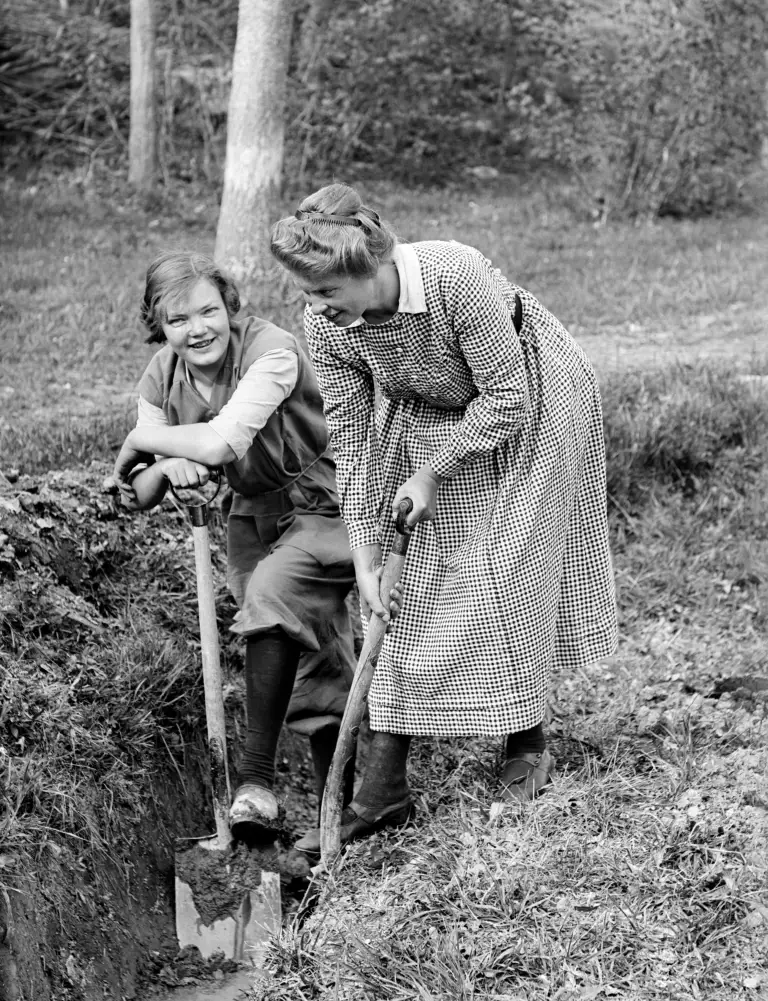
Working in the garden. Strömmen farm, Sankt Anna parish, Östergötland. Taken by Emil Durling in 1915. Östergötlands museum, Linköping.
In 1915, Durling photographed Ester and Ölle digging a trench on his farm. Ölle, wearing a short work dress, long stockings and clogs, has one foot on the spade to cut through the turf and soil as she stands in the wet trench, while Ester, wearing a slightly longer work dress, long stockings and shoes, stands on the turf and leans on a shovel to keep the trench walls from collapsing. These two longtime friends are a team performing a physically demanding task they are accustomed to doing. Later Ester became a teacher and married, both signs of her respectability.