Doing Laundry

John Alinder and others doing laundry at the Alinders’ farm. Sävasta, Altuna parish, Västmanland (now in Uppland). Taken by John Alinder, undated. Upplandsmuseet, Uppsala.
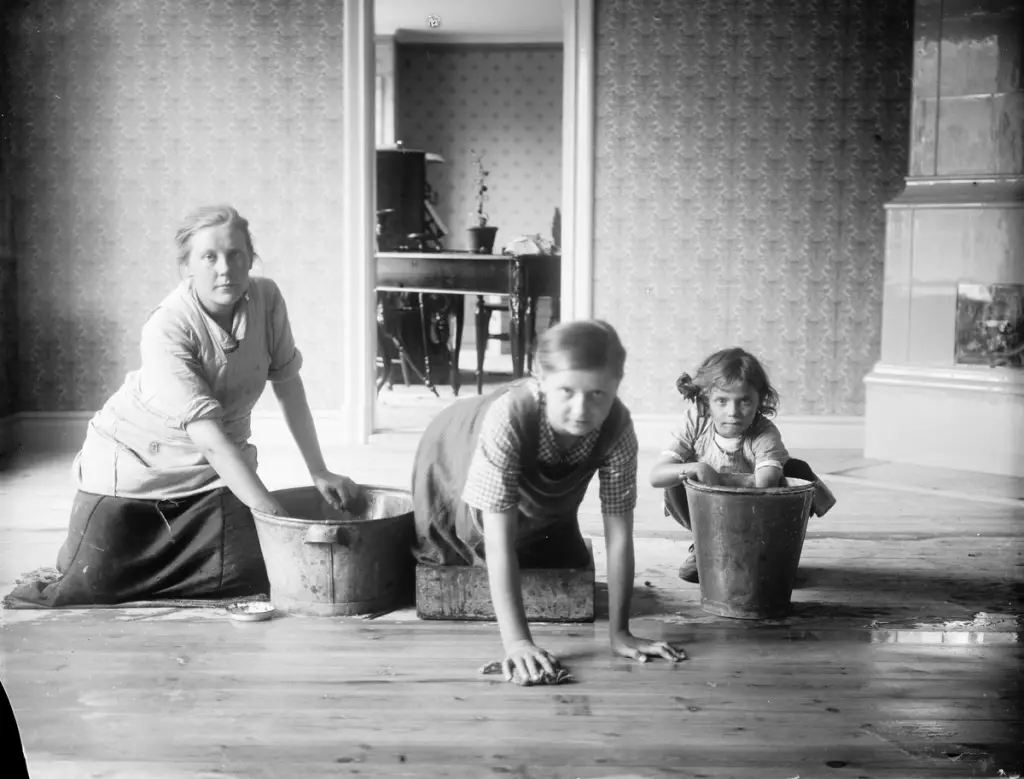
Few photographs of women performing household chores are found in the archives before the middle of the twentieth century. The technology was not suited to taking pictures of indoor activities, and few photographers or viewers were interested in tasks they regarded as routine. John Alinder’s extensive body of work includes images of women filling pails at the outdoor water pump, scrubbing the front stoop, shelling beans on the porch, and feeding the hens outside the kitchen door.
In the spring and fall, large loads of household linens were soaked, scrubbed, rinsed, bleached, and dried outdoors next to the farmhouse, with water drawn from the well and heated in large cauldrons. John Alinder documented this laborious process on his parents’ farm, where everyone was accustomed to his fascination with recording the quotidian details of rural life. He used a delayed shutter release to include himself in some of these images.
Here one man pours water into a washtub while another helps with the heavy lifting, and two women with soap in their hands bend over wooden scrub boards and washtubs. In other photos, the same women appear washing and bluing linens in tubs that are already full of water, as well as pumping water by themselves. If we saw only those images, we would never know that in this family the men assisted the women with the heavy task of drawing, carrying, heating, and pouring water into washtubs and squeezing water out of wet cloth in hand-cranked mangles.
The men who participated in this mammoth task were neither young nor elderly, who might regularly assist women with household tasks, but able-bodied adults. And these physically fit women toiled alongside their menfolk in haying, harvest, and other field work as well. Those whom the photographer identified by name were linked by kinship and marriage. In addition to those living in the household, they included John’s married sister Anna Alinder Johansson, her sisters-in-law Maja Johansson and Agnes Johansson, and Hildegard Pettersson and Valborg Persson, who lived nearby.
The Alinders were able to draw on so many adult women and men to work together on routine farm and household tasks because older parents, adult children and their spouses, and married siblings lived in Sävasta, a village in Altuna parish where the farmhouses and barns clustered together and were surrounded by cultivated fields rather than each standing alone in the midst of its fields. Indeed, John Alinder may have been able to spend so much time making photographs in part because he, his wife Tora, and their son Tove shared their house with Tora’s widowed mother, and John and Tora worked on John’s parents’ and his married sister’s farms rather than farming on their own.
In the absence of similar evidence from elsewhere, it is impossible to know how common this kind of cooperation was. Women were willing and able to take responsibility for tasks that men ordinarily performed but were unable to do because they were away or busy with other equally pressing matters, but how many men joined their womenfolk on washday? In the early twentieth century, many farm women in Sweden and elsewhere complained about having to carry water long distances from the pump or well to the house. The practical solution, as they saw it, was to install running water in the kitchen. Perhaps the sharing of this heavy labor in the Alinder family was possible because so many relatives lived and farmed in close proximity. That pattern was becoming less common in the early twentieth century as farm consolidated, leaving rural women and households in a more isolated position than before.
Working in the Cowshed

Inside the cowshed on Gunnar Johansson’s farm, Mälby, with cowshed man Larson and milkmaid Lindgren. Frösthults parish, Uppland. Taken by John Alinder in 1928.
Men began working in the cowshed as the size of dairy herds increased, but men did not milk by hand. Most of the women and men who worked in the cowshed on larger farms were hired laborers rather than members of the landowning family. The newly built cowshed on Gunnar Johansson’s farm, which was larger, brighter, and better ventilated than its predecessor, could house at least 16 cows. The women did the milking, while the men carried the feed to the troughs and mucked out the floor.