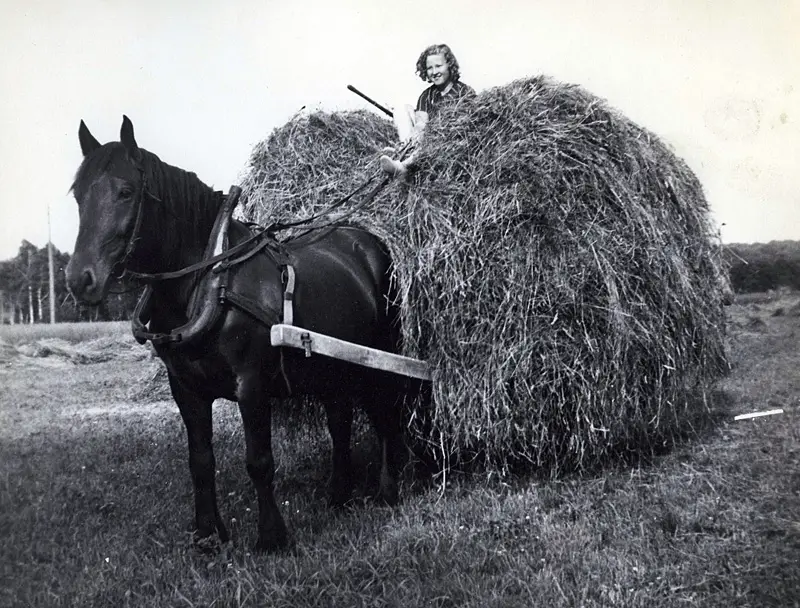
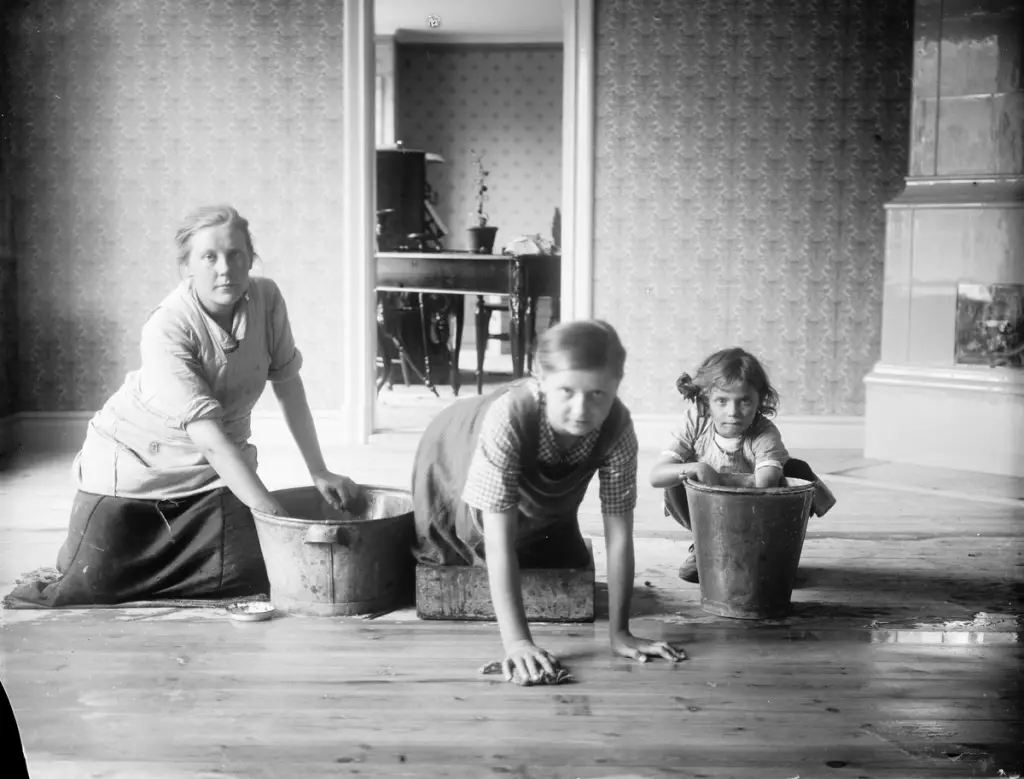
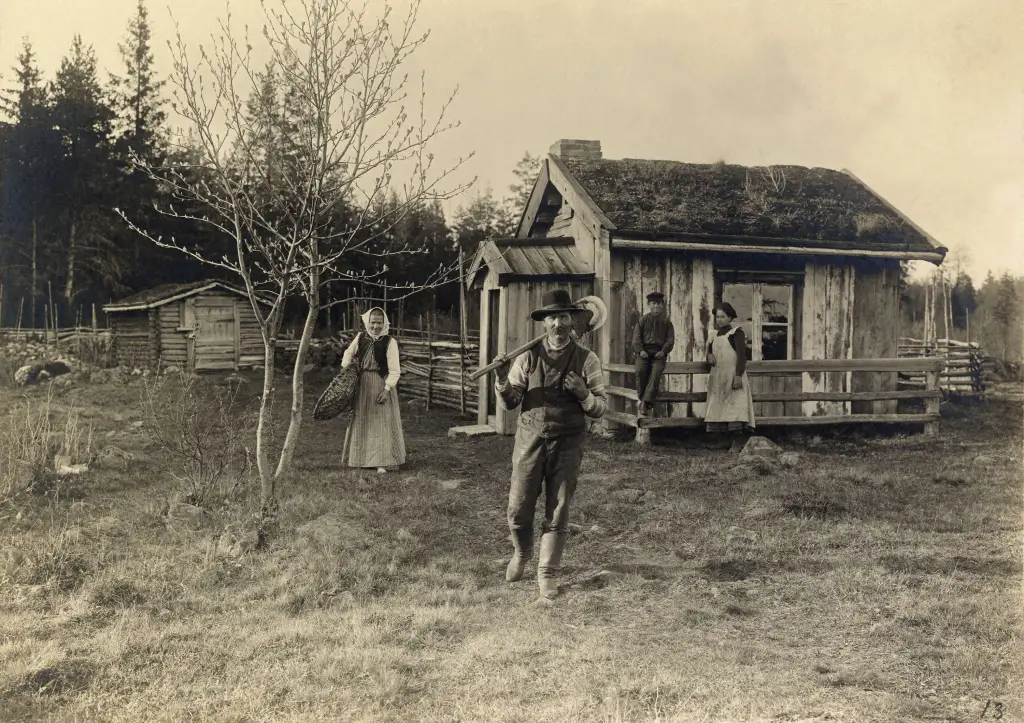
Ida Häckner and Gunnar Lundh were consummate professionals. At the other end of the spectrum are skilled amateurs who photographed their relatives, friends and neighbors as they went about their daily and seasonal farm work. Swedes were as enthusiastic about the amazing power of photography to capture and preserve passing moments as their counterparts elsewhere. Some learned how to expose and print glass-plate negatives, despite the cumbersome equipment and exacting processes involved, well before the advent of simpler cameras using film. They devoted their skills to recording life in their own communities in depth and over time. Rather than charging the people they portrayed, amateurs gave them their choice of prints.
Comparing photographs of rural subjects taken by professionals with those by amateurs reveals significant differences as well as common themes. Professionals were outsiders to most of the people and places they documented, while amateurs were familiar insiders. Their subjects were less likely to be shy or self-conscious, freer from worries about how they would appear to others, and more comfortable with the person behind the camera. The photographers, in turn, were more aware of individuals’ distinct personalities, characteristic expressions, and ways of interacting with others. Their dynamic images are more varied than the conventional compositions favored by professionals.
These qualities make amateurs’ representations of women working on farms especially valuable. Professionals and amateurs were aware of the value of women’s bodily labor to farming families and landless households. Women were versatile and flexible, as their strength, skills, and endurance enabled them to spend long hours toiling outdoors as well as in the cowshed and the house. They not only complemented male labor in the fields but also substituted for men when extra hands were needed.
Despite this shared perspective, amateur photographers paid closer attention to the full range of women’s labor; more often focused on women’s interactions with their coworkers of both sexes; and highlighted their physical contact with the environment—the tools they used, the animals and crops they tended, and the soil on which all else depended—rather than posing them as static, even statuesque figures against a generic background.
Two photographs taken by skilled and dedicated amateurs exemplify these qualities. Karl F. Andersson (1865–1949) learned to make photographs from his father and photographed scenes of rural life in Skaraborg county, particularly of old-fashioned houses and the old people who lived there and continued to cultivate the land with hand-held implements.

Gabriel Jonsson, his daughter Selma, and his wife Johanna Jonsson harvesting grain. Sjogerstad parish, near Skövde in Skaraborg (now Västergötland). Taken by Karl Fredrik Andersson, Selma’s husband, around 1910. Västergötlands museum, Skara.
Karl Andersson placed his wife in the center of the frame as she looks at him, suggesting their reciprocal intimacy and their embeddedness in her kin group. Consider the posture and dress of these figures. Selma looks directly at her husband behind the camera, while her parents focus on the task at hand. Her clothing is typical for women working outdoors: a headscarf to keep her hair out of her face and free of debris; a white blouse with long sleeves to protect her arms from scratches and sunburn; a long white skirt that is full enough to allow her to move freely, and a vest. Her mother Johanna is dressed in black, with a scarf tied under her chin. Her father Gabriel’s cap has a visor to shield his eyes from the sun; his checked shirt has a removable white collar, which serves as a sweatband, as well as gathered wristbands; and his pants are held up by suspenders, which accommodate his swinging arms and forward steps. The geometry of this photograph’s composition places the three bent figures in a triangle and directs the viewer’s eyes to where the subjects’ hands grasp their tools and the grain, emphasizing the coordination that comes from years of working together in the field.
An unusual photograph by John Alinder captures a problem that all too often arose when heavy machinery was used on soggy fields.

Farm workers with a machine. Sävasta, Altuna parish, Västmanland (now in Uppland). Taken by John Alinder, undated. Upplandsmuseet, Uppsala.
Two men and a woman struggle to right the machine and free it from the mud, while another woman and a man sit and watch. By placing the woman pushing and lifting the machine in the center of the frame and focusing on her clothing, whose folds emphasize her vigorous movement, Alinder conveys the muscle power she brings to this group effort. Indeed, she is the most dynamic figure in the trio, as the men peer down and tinker with the works. This image does not depict her as the static object of the photographer’s gaze, but conveys her body’s balance between fluid motion and stability.
A self-taught photographer, Alinder continued to use the glass negative process because, in his expert hands, it offered unparalleled depth of field and a sharp image of both nearby people and the land they farmed. His departures from conventional subjects and poses indicate his close ties with the people he depicted, who were so comfortable with him and his camera that they allowed him to record their awkward moments as well as their routine tasks.