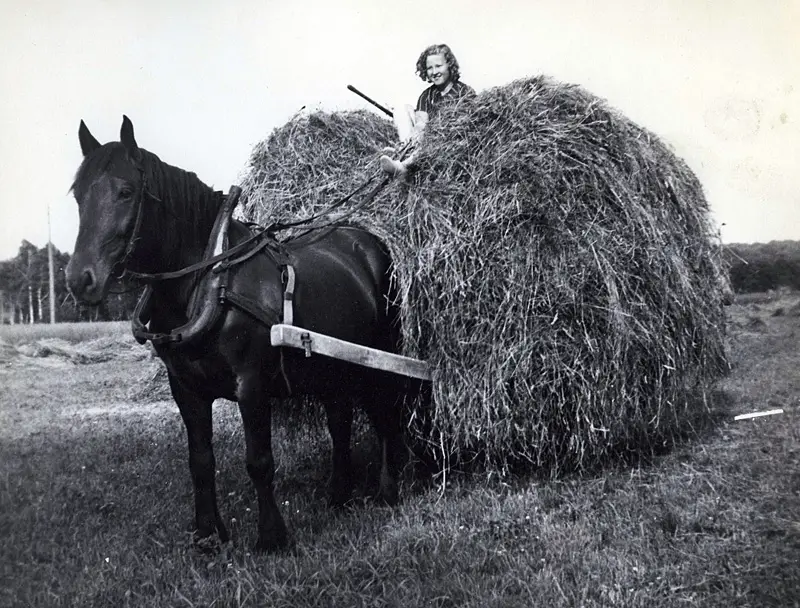
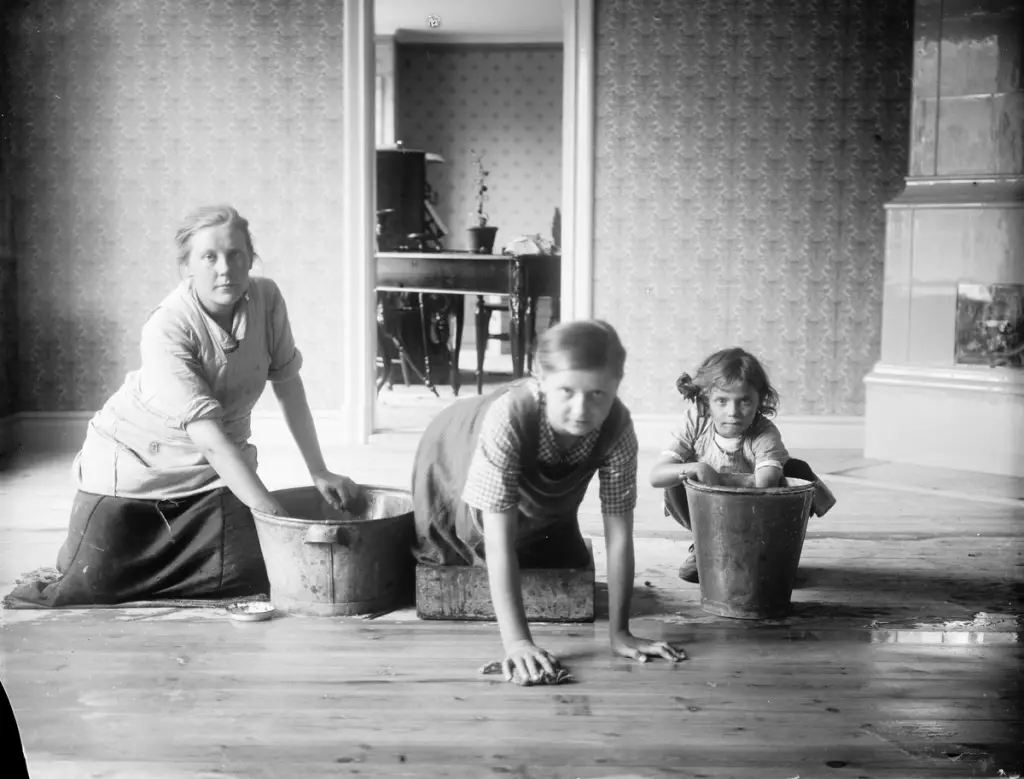
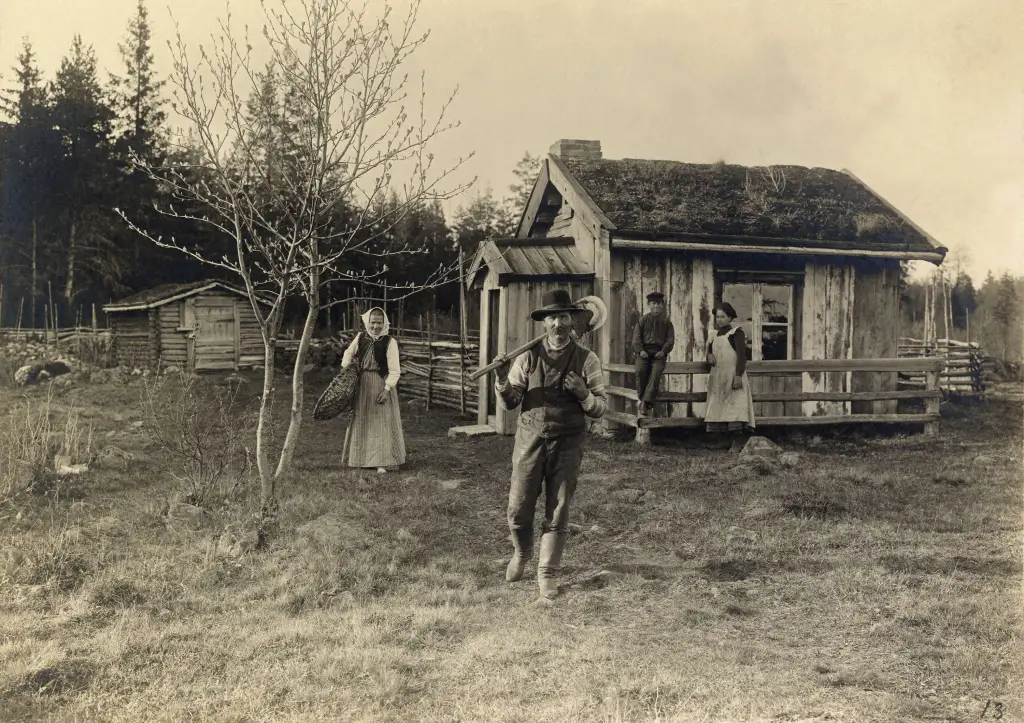
Seasonal operations such as making hay and harvesting grain required larger work crews composed of men and women from neighboring households and laborers of both sexes hired by the task or the day. Adult men used scythes cut hay or grain, and women, older children, and aging men raked and turned the hay and put it on drying racks or raked up the grain and bound in into sheaves.
Compare the composition of these two images of a group of harvesters, which were taken in quick succession by John Alinder.


[AL0639] and [AL0643]. Harvest work on L. Johansson’s farm. Sävasta, Altuna parish, Västmanland (now in Uppland). Taken by John Alinder in 1918. Upplandsmuseet, Uppsala.
In the first image, the landowning farmer stands front and center with a scythe, and three men and two women stand in a semicircle around him facing the camera. One younger man also holds a scythe, and the other men and two women will gather the stalks of grain and bind the sheaves with their bare hands. This composition emphasizes Johansson’s position as the group’s leader for the day. In the second image, however, Johansson and the younger man are on the right and left, and the man and woman who gather and bind the grain that each man cuts stand next to him. This arrangement accentuates the two gender-mixed work teams.
Both these arrangements are common conventions found in many other images of gender-mixed groups of harvesters and haymakers, but it is unusual to find both at once. These contrasting views, one more hierarchical and the other more collaborative, were not antithetical; multiple aspects of labor organization were play in most scenes of harvest and haying.
John Alinder photographed this group of harvesters on the Johanssons’ farm in the village where the Alinders also lived. L. Johansson may well have been a paternal relative of John’s married sister, Anna Alinder Johansson, who lived with her husband Gunnar in the same parish. Gender-mixed groups of harvesters often included adult children of the landowning couple; they had grown up on the farm, and those who had moved away often brought their spouses to work alongside them when they came to help their parents.
Two photographs of a village-based group of harvesters taken a decade later show the mix of men and women that was needed when a horse-drawn reaping machine had replaced men wielding scythes. It cut the standing grain more quickly, so it took more people to gather and bind it


Preparing to harvest grain with a horse-drawn reaping machine on a farm. Vadsbo parish, Skaraborg (now Västergötland). Taken by Gustaf Wennerholm around 1930. Västergötlands museum, Skara.
Although both these photographs show the same harvest crew before they began work, they are arranged differently. In the first image, an adult woman and an adult man stand on each side of the horse team. Strikingly, the woman looks as sturdy and as capable of handling the horses as the man. The boy, two men, and three women who gather and bind the grain stand behind the machine, and a girl sits on the lap of the older man who operates the controls.
In the second image, however, this group is organized by gender rather than by kinship and generation. Two adult men stand at the head of the team, in keeping with the notion that men were in charge of draft horses. The man on the left is accompanied by the boy. The women stand in two rows to the left of the team and the machine. An adult woman and the girl are in front. Behind them are three women and one man; another man sits on the operator’s seat. Together, these two images suggest that women and men worked together in interchangeable configurations, rather than in strictly gender-defined positions.
Gustaf Wennerholm (1865–1946) was a teacher in the local folk high school as well as a skilled amateur photographer. His photographs, most of which were taken in the 1920s and 1930s, include portraits of his relatives and friends and scenes in and around his rural parish north of Skövde.