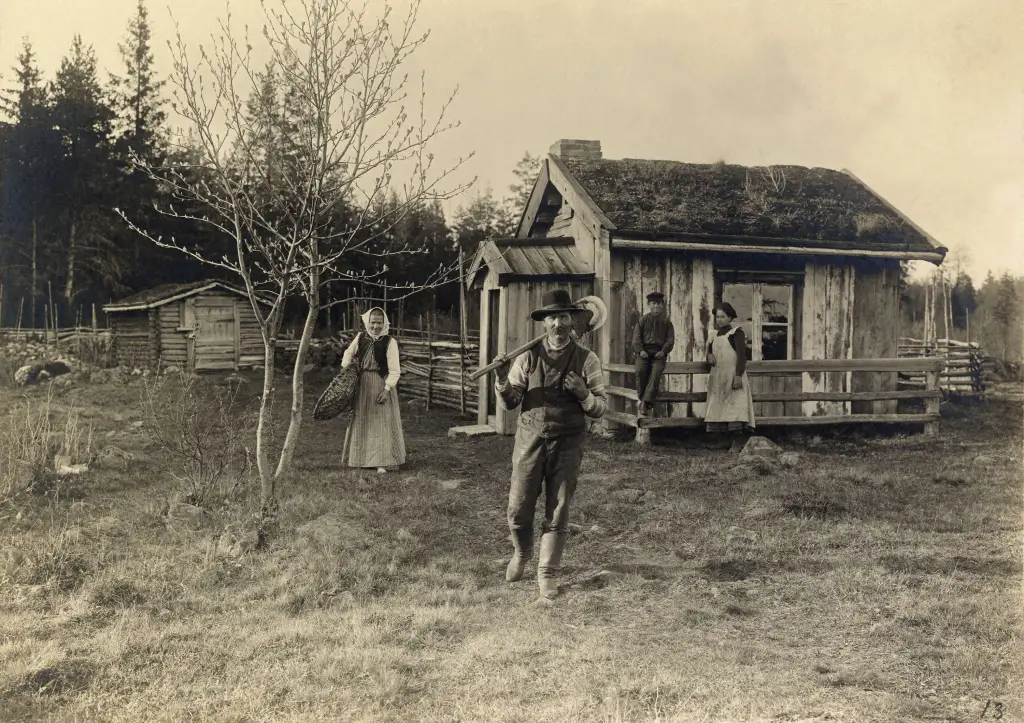
Family outside their farmhouse. Near Skövde, Skaraborg (now Västergötland). Taken by Anders Karlsson in 1936. Västergötlands museum, Skara.
Conventional photographs of landowning farm families emphasize their resources of land and labor, but subsume women and men, relatives and employees, into family-centered units. During the early twentieth century, families increasingly identified themselves with a specific farm, although some bought nearby plots to increase production or to balance the different types of land they cultivated.
Anders Karlsson (1893–1967), a freelance documentary photographer who became famous for the diversity of people and places he recorded, bicycled around the Swedish countryside with his camera during the 1920s and 1930s. His favorite format was a two-level image with the family posed outside their dwelling above and a wide-angle view of their land below.
This farm family included the husband and wife, their six children, and two other women—likely the sister and mother of the husband or wife—standing in their front garden and along the road amidst their outbuildings and fields. Adult female labor was needed to carry out household chores, milking, gardening, and child care simultaneously, as well as working in the fields alongside men at busy seasons. When an unmarried sister or widowed mother was not available, a couple whose children were all too young to work might hire a maidservant rather than a farmhand.

Family gathered on their estate. Skaraborg (now Västergötland). Taken by Carl Victorin, 1890–1900. Västergötlands museum, Skara.
This photograph includes eleven people, including members of three generations of the landowning family as well as hired men and maidservants who lived in the household. The decision to exhibit two draft horses and several of their dairy cows and heifers attests to their pride in their livestock, and the long barn suggests the scale of the operation.
What does the women’s and men’s clothing suggest about the family’s class position? Can the maidservants and hired men be visually distinguished from the female and male members of the landowning family? In most farm family photographs, household members are arranged by age or generation and ties of kinship and marriage, while hired workers are in the background. But that does not seem to be the case here, as several are stand with the animals they care for.
Carl Victorin (1842–1914) was an itinerant photographer as well as a land agent who negotiated the sale and purchase of farms, so his camera gave him entrée to communities where he wanted to do business. How might his personal interests have shaped this image?
Photographs of families and farms taken by amateurs are more varied than those taken by professionals. Avoiding conventional compositions, they portrayed people they knew in ways that conveyed their personal qualities and relationships. Equally important, their subjects rather than the photographer decided how they would be arranged. Two photographs by John Alinder represent the range of family configurations that emerged when the subjects took charge of the composition.

Johan Eklund’s family outside their house. Fallet, Tärna parish, Västmanland (now in Uppland). Taken by John Alinder in 1919. Upplandsmuseet, Uppsala.
Here “Mamma Frida” stands in the center. To her left are sons Evert, Axel and Gösta, and to her right are daughters Annie and Mary. The husband and father is not in the picture, which makes this composition unusual. Perhaps, like many of his compatriots, Johan had gone to America, and this photograph was taken to send to him.

Family with people and horses in front of the house of Severin Eriksson. Ulleråker, Simtuna parish, Västmanland (now in Uppland). Taken by John Alinder in July 1926. Upplandsmuseet, Uppsala.
The father, Severin Eriksson, and young son, Sven-Erik, show off the draft horses and colt in the front yard. The mother, Hilda-Emilia Eriksson, stands on the porch holding daughter Valborg Ingegärd Emilia. The older couple on the porch are not identified, but they were probably the parents of Severin or Hilda-Emilia; they had either passed on this farm their son when they retired or moved to this farm when they needed their daughter’s care. The gendered organization of this composition—especially the placement of the son alongside the father—emphasizes the connection between men and horses, which were used for field work and transportation. When dairy cows appear in portraits of families and farms, as the photograph taken by Cark Victorin shows, they are almost always with the women and girls, who cared for and milked them.
Compare the central position of the father in the Severin family configuration with that of the mother in “Johan Eklund’s family.” What impression does the gender-divided composition of this photograph create of power relations within the Severin family?